
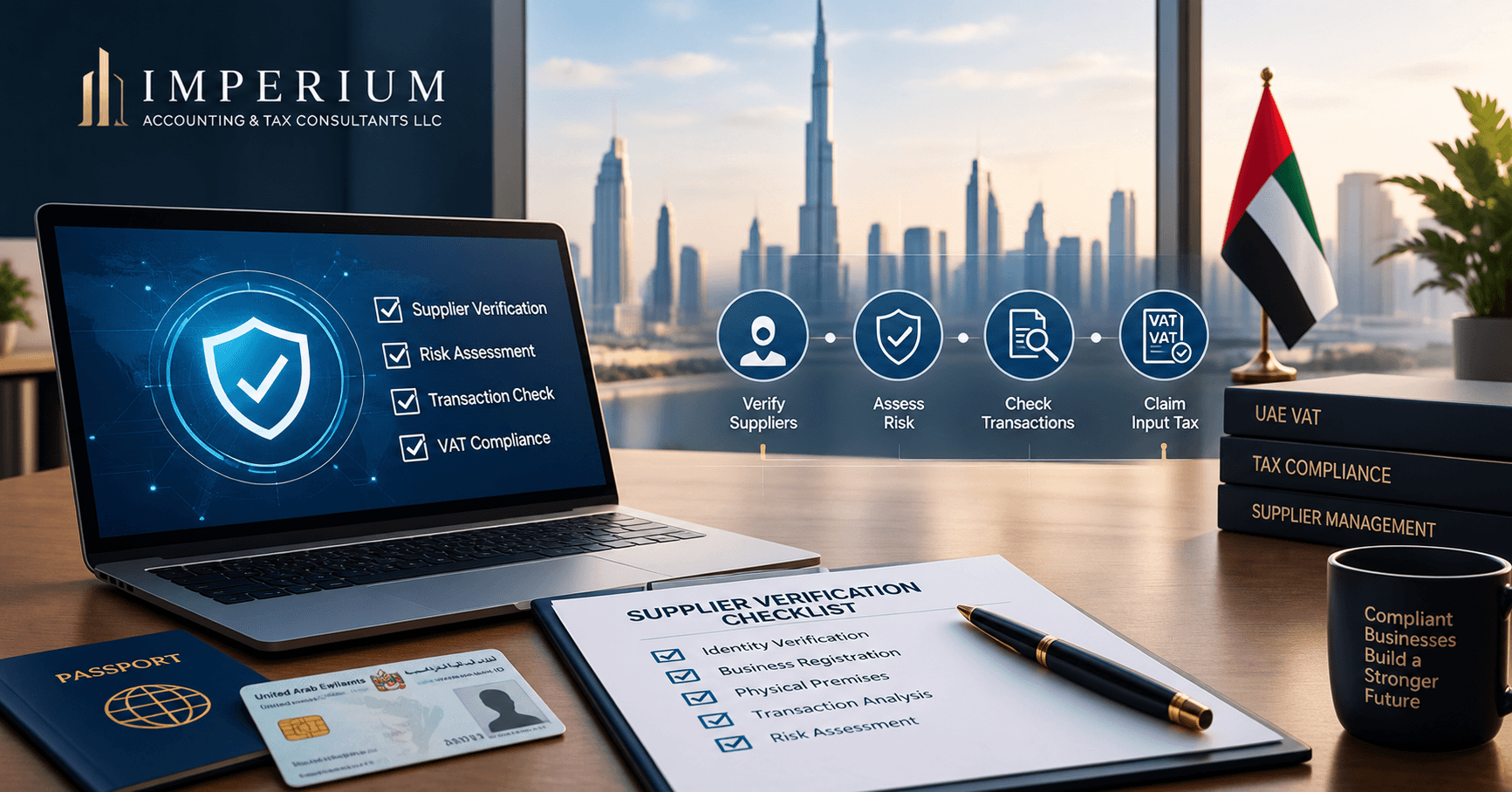
The UAE’s VAT framework is about to undergo one of its most significant shifts since 2018. Effective October 1, 2026, FTA Decision No. 13 of 2026 introduces mandatory supplier and transaction verification requirements that will directly impact how businesses claim input tax. Gone are the days when a tax invoice alone was enough. Now, you must prove your suppliers are legitimate, their premises exist, and your transactions make commercial sense.
This new regime is designed to protect tax integrity—but it also places a heavy compliance burden on businesses that are not prepared.
Supplier Verification: A New Mandatory Step Before Input Tax Recovery
Under the new rules, businesses must verify suppliers before claiming any input tax and repeat this verification every 12 months.
For individual suppliers, this means confirming identity through Emirates ID or passport and meeting them physically or virtually before the supply occurs.
For corporate suppliers, the requirements are more extensive. You must:
- Confirm legal registration through official databases
- Verify the identity of the authorized representative
- Validate the physical existence of the supplier’s premises—electronically or through an on‑site visit
If your onboarding process relies solely on email communication, this update requires a complete rethink.
Risk Assessment: Identifying Red Flags Early
The FTA expects businesses to actively assess supplier risk. Watch for:
- Frequent changes in address or key personnel
- Unusually large or unexpected transactions
If your dealings with a supplier exceed AED 375,000 in a 12‑month period, you must also verify their UAE bank account and review their public reputation. These checks are now mandatory components of VAT compliance.
Transaction Reality: Ensuring Commercial Logic
Even if your supplier is legitimate, the transaction itself must be commercially sound. Before claiming input tax, evaluate:
- Whether pricing aligns with market rates
- Whether the goods or services match the supplier’s licensed activities
- Whether payments follow standard routes without offshore or third‑party detours
- Whether intermediaries have a clear commercial purpose
These checks help ensure the transaction reflects genuine economic activity.
Small-Value Exception: Useful but Limited
Transactions below AED 10,000 (excluding VAT) qualify for simplified verification. However, this exception disappears once annual purchases from the same supplier exceed AED 100,000.
To remain compliant, every business must maintain a written internal tax policy assigning responsibility for verification, review, and oversight.
Imperium Call to Action: Stay Compliant. Stay Protected.
At Imperium Accounting & Tax Consultants, we help UAE businesses navigate regulatory changes with clarity and confidence. Our team can:
- Build your supplier verification workflow
- Conduct risk assessments and compliance checks
- Draft your internal tax policy
- Review your supplier portfolio before October 2026
- Protect your input tax claims from FTA challenges
Don’t wait until the new rules take effect. Strengthen your compliance today. Reach out to Imperium and ensure your business is fully prepared for the 2026 VAT changes.
Imperium Editorial Team
Accounting & Tax Insights
Research and analysis from the Imperium Accounting & Tax Consultants LLC team, reviewed for accuracy before publication.